Compact System Cameras, Mirrorless DSLR, Next Generation Cameras – Pick a Name these cameras are making their mark

Although I love my Canon S90 point and shoot, I decided to purchase a mirrorless DSLR. This small size camera with its larger sensor will give me better quality images than my point and shoot. I did my research and narrowed my choice down to the 14 megapixel Sony NEX-5 or the 12 megapixel Panasonic Lumix GF-1. Both are very good cameras and both come with pros and cons.

Sony NEX-5

The Sony NEX-5 does better at higher ISO’s, does sweep panoramas, has a tilt out LCD screen and has as internal stabilization that works for all lenses. I plan on using a pancake lens with my system to keep the package small. Sony has a 16mm lens that’s equivalent to a 24mm on a full frame camera. It’s a good lens but it may be too wide for my everyday use. For me, the down side of the Sony is that it doesn’t have a hot shoe or a built in flash. I like having a hot shoe because I can slide an optical viewfinder on the camera. The optical finder helps me to compose in bright sunlight when the LCD screen is difficult to read. The finder also is a plus when shooting at slower shutter speeds. It allows me to press the camera against my face for added stability. Although the Sony has no built in flash, there is a small add on unit, but it is a bit awkward and changes the camera’s profile.

Panasonic Lumix GF-1

The Panasonic GF-1 does have a small built in flash and a hot shoe. However the sensor is a little smaller than the Sony and the image quality at higher ISOs isn’t as good. The GF-1 is larger than the Sony but it fits my hands better. I like the physical exposure mode dial and the drive selection lever on the GF-1 in contrast to the Sony’s exposure and drive functions, which are buried in a menu on the LCD screen and are not as user friendly. As far as pancake lenses go, the GF-1 comes with a 20mm lens that is the equivalent of a 40mm on a full frame camera. This lens is too long for me and I would prefer something wider. That problem has been addressed by Panasonic with the addition of a14mm lens, equivalent to a 28mm on a full frame. This focal length works well for my purposes.

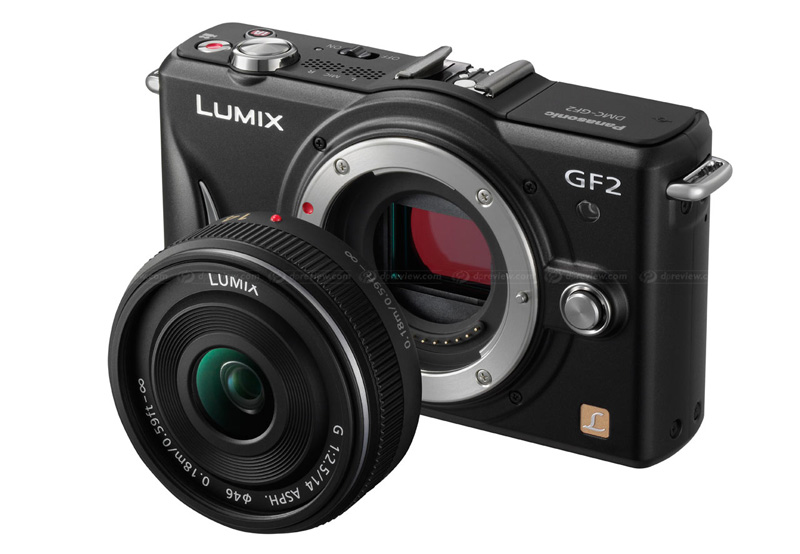
Yesterday, still undecided on which camera to buy I stopped at Fotocare my camera store in New York. I had the opportunity to play around with the new Panasonic Lumix GF-2, which will be available next month. What I had read about this camera didn’t impress me: the physical exposure mode dial and the drive selection lever had been eliminated and installed into the touch screen menu in order to make the camera smaller and more competitive with the Sony. I thought these changes would be a deal breaker and would force me to look around for the soon to be discontinued GF-1 if I decided to go the Panasonic Lumix route. I was pleasantly surprised, however when I found that these functions were extremely easy to access and would not be an issue. The newer Lumix GF-2 also has the ability to shoot almost 3 frames per second, a rate fast enough to capture changes in people’s expressions. It also has a new processor which I hope will make better images at the higher ISOs. For video users, the camera shoots 1080 hi definition video a feature the Sony also has.

There are some other good, small pocket sized mirrorless DSLR cameras on the market; the Olympus Pen EP-2, or the Samsung NX10 are two of the more popular ones. And all these cameras have a lot more features than I mentioned. My choice is based on how and what I shoot. You can find more detailed reviews and information on the web, a good starting point is the bythom website. As of this posting, however the GF-2 looks like the camera that will work for me. I hope to have one in my hands in the next few weeks to use in a real world test. I will post the results on the blog.

The way the digital camera market is changing, Sony may come out with a new camera by the time I return from my current trip to Abu Dhabi. Nikon plans to enter the marketplace in the near future and I’m sure Canon won’t be far behind. One thing is certain -though you can’t keep a head of technology, you still can keep taking pictures with the equipment you have.

Back Up Your Camera

I know everyone is now backing up their digital images in many different places (at least I hope so), but what about camera backup? I’m leaving Antarctica, heading back to New York down one camera body, my fault for not respecting the limits of my equipment. A few days ago I was photographing penguins and icebergs in the rain, a mild rain. I kept on shooting until my Canon 5D Mark2 stopped working and came up with an Error 20 message. I had used this camera many times in the past in the rain and had encountered no real problems. And although I had a rain cover for it in my backpack, I did not bother to cover the camera. Was I being lazy or did I just have too much confidence in the camera’s weather resistance. And when is a photo worth losing a camera?
When I returned to the ship I took out the battery and CF card and left everything open. I put the camera in a plastic bag with desiccant, hoping it would dry out overnight but the camera still wouldn’t function the next morning. Fortunately I had a backup camera, a Canon7D. The 7D was out in the rain with me when the 5D died but it continued to function.
As I am headed out to Abu Dhabi a week after I return to New York, I sent Canon repair an email to ask if they could fix the camera and get it back to me asap. Their answer was yes. I decided to push the envelope a bit with Canon: as long as I was sending the disabled camera in for repair, I thought I’d send the 7D and another 5DMark2 to be checked. I also wanted Canon to install the new mode selector locking mechanism on all three bodies. When you’re working with gloves and heavy clothing, that dial seems to mysteriously turn from your original setting to one that you’ve never heard of. And even though I don’t anticipate wearing cold weather gear in the desert, I want to ensure that the mode selection dial doesn’t inadvertently move when I pull a camera out of my bag.
If you are going somewhere special, on holiday and especially on assignment, respect your equipment. If you don’t, be prepared with some backup.

Take Off That Polarizer

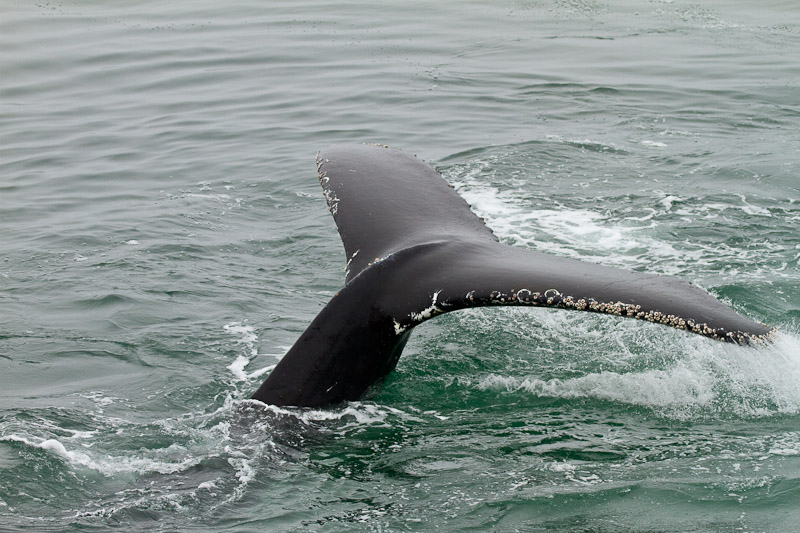
High shutter speed, and not a polarizer captured this Humpback Whale's tail

It never fails. Every time I teach a photo workshop, I notice that at least 25% of the participants have a polarizing filter on their lens and they never take it off. Here on board the National Geographic Explorer in Antarctica I’ve been using the phrase “Just because we’re in a polar region, you do not need a polarizing filter!” This onslaught of polarizing filters must be a result of camera sales people trying to sell more gadgets to their customers with the promise of better images through polarization. Yes, polarizers do have their place in photography, but definitely a limited place.
I’ve always believed that putting a filter in front of your lens deteriorates the sharpness of your glass and since polarizers use two pieces of glass the results are worse. Also, the loss of 1.5 to 2 stops of light is quite significant; especially if you are trying to shoot penguins, seals and whales from a moving ship and need a high shutter speed.
What situations warrant the use of a polarizing filter? If you shoot a landscape with blue sky and puffy clouds and you want the sky to look dramatic, you can use your polarizer but keep in mind that it is only effective if the sun is 90 degrees off your subject. Even then, I think that this look is a bit old fashioned and should be used judiciously.
A polarizing filter will also eliminate the reflections that occur if you shoot through glass. Use one if you want to photograph the Christmas windows at a big department store. If you need to shoot copies of art work that have a high gloss finish you should also polarize your light source in addition to using a polarizing filter.
When you are shooting scenes that include a large body of water, a polarizing filter will eliminate the glare that can occur from the sunlight. Keep in mind however that sometimes glare can make the water look moody and more realistic. Some photographers use the polarizer when shooting fall leaves to help saturate color. However, if you want a reflection of trees and leaves in a lake, you will need to remove the filter or you will lose the reflection.
If you plan on buying a polarizer spend a little extra money and get a good one that won’t compromise your high quality optics. Always test the filter in the store with your widest lens to be certain that it won’t cause vignetting. The polarizer is a thick filter; if you anticipate using it with a wide lens look at the special, thin polarizers made for wider lenses. Never use a polarizer to protect the front element of your lens. Get a UV, haze or skylight filter for that purpose
I do carry a polarizer with me, but I only use it when I think it will help make a better image. In many instances the use of a polarizer is a subjective decision and is based on the type of image you like to shoot.
But if you need a good shutter speed to shoot something moving and the situation doesn’t warrant polarization, take the filter off and get a sharp picture. More equipment doesn’t always make a better photograph.

Abu Dhabi Desert Workshop

January 20, 2011 Qasr al Sarab Resort

If you’re near Abu Dhabi on January 20, Ira is doing a workshop in the desert at the incredible Qasr al Sarab Resort. We will be out shooting the fantastic desert landscapes, camels and a nearby oasis.