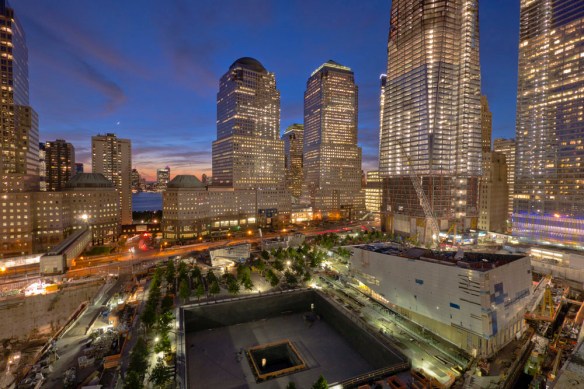
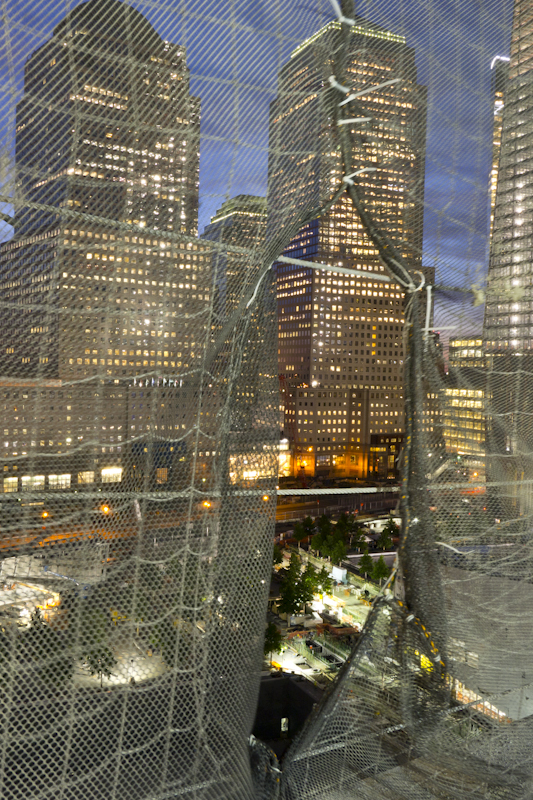
Panasonic GH2 7-14mm lens at 9mm. ISO 160, 6 seconds f/10
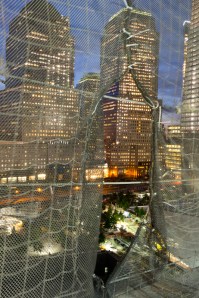
The "Hole"
When the sun goes down don’t put your cameras away, instead grab your tripod and enter a new world of imagery. I’ve been doing ‘night’ shots for many years and the key to making great night photos is simple – don’t wait until it’s totally dark, unless you are planning on photographing stars. If you are shooting landscapes or city scapes, a black sky will not work. Immediately after sunset, a diligent photographer can take advantage of the ten minute window when the sky has a warm glow and there’s still enough light to help illuminate your landscape. You can find color in the sky after sunset; the secret is knowing where to look.
The eastern sky turns cobalt blue while the western sky, where the sun sets will acquire nice pink and blue tones. Of course much of the color is dependent upon atmospheric factors: cloud cover, smog, dust, water particles in the air and the time of year.
When shooting a cityscape with buildings, the lights in the windows add even more depth to your final photo. The best time of year for these shots is in the winter when the sun sets before five or six o’clock and everyone is still at work. In the summer, city scapes can be problematic because the sun sets between seven to ten pm (depending on how far north you are),and because most workers are out of their buildings, the office lights are turned off.
It is best to use a tripod when shooting at night, even though you can set your digital camera to ISO 6400 and hand hold it with a fast lens. With a tripod you can stay at a low ISO and get a good quality file. The higher ISO will give you a lot of noise and that noise will be accentuated in the shadow areas in your image.
Here are some quick tips for night shooting:
• Use a sturdy tripod; a small tripod extended to the max is not stable.
• Use a cable release so the camera doesn’t move when you press the shutter. If you don’t have a cable release, trip the shutter using the self timer.
• Use a low ISO.
• Pick the sharpest lens aperture; it’s usually two to three stops down from wide open.
• Be careful that your camera meter does not take its reading directly off of a highlight or shadow.
• Although you will usually be set at infinity, be aware of where the camera is focusing.
• If the meter reading and the focus are a problem, take the camera off automatic. Use manual focus and manual exposure.
• Lock up your camera’s mirror. The motion of the mirror going up and down can cause camera shake.
• Finally, turn on the camera’s long exposure noise reduction.
There is debate among photographers as to how efficient this is. Some like to use the noise control in Photoshop. My opinion is that the camera does a better job. The downside is that after you take your photo, the camera does another ‘dark frame’ for the same amount of time as your original exposure, which results in a delay before you can take the next picture. The delay is caused by signal to noise ratios and the size of sensor sites; much too technical for the purposes of this blog. (If you want to learn more about it you can do a search.)
Technical aspects aside, shooting at night requires common sense. Get to the location early so you can scout it out and find a good position. Bring a flashlight; by the time you are done it’s going to be dark. Even better than a flashlight, wear a head lantern which frees up your hands. I recall an assignment in Utah when I went out on my own to do a night landscape. The area was quite remote and I had to carry all of my equipment down a steep and slippery path in the dark. There was no cell phone service and had I tripped or fallen and injured myself, I would have been in a lot of trouble. The lesson: don’t go out alone.
For this photo of ground zero in New York City looking west, I got to my location very early. I was shooting from a building under construction and I had to wear boots, a hardhat and an orange vest. I also had an escort with me from the building developer. Our first obstacle was that the construction elevator wasn’t running because it was the end of the day for the construction workers. We had to walk up ten flights of steps with my equipment to get to the right position. The second and almost deal killing obstacle was that in New York as in most cities, safety regulations require that buildings under construction be wrapped in netting to prevent construction material from flying below. This netting was so fine that I couldn’t place my lens through it. I thought my photo was not going to happen until I noticed that various sections of the netting were fastened together with locking cable ties. When I asked my escort if I could cut open a few of these ties, he was skeptical. Finally, he granted me permission on the condition that I close the netting with cable ties when I finished shooting. If I was going to take this picture, I needed to find cable ties; an item that I have plenty of in my studio but none in my camera bag, here on the tenth floor. Having come this far and high up, I couldn’t let the opportunity pass. I canvassed the construction bins around the various floors of the site, like a homeless person sifting through garbage cans. Ultimately I got lucky and found a box of cable ties. The photo was going to happen.
The sun went down that evening around 8:22PM. But since I was shooting west into the sunset, balancing the bright sky with the unlit, memorial fountain and barely lit trees wasn’t possible. The sky was darker by 8:40PM but the exposure for the dark shadows in the trees was going to render the sky too bright. Although it would have been easier looking into the darker, eastern sky that angle and direction wouldn’t give me the composition I was going for. It wasn’t until 9:00PM that the light came together and I was able to start taking the pictures I wanted. Working in the dark can be an enlightening experience.


 Ira Block Photography