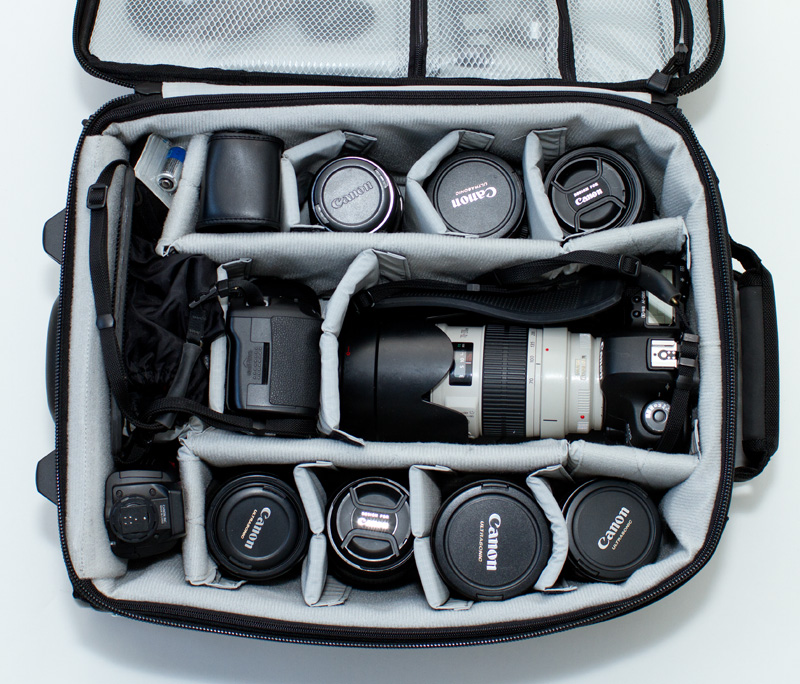
Tenba Roadie II Univeral filled with my equipment
Like most photographers, I own a variety of shoulder strap camera bags and back and fanny packs that I use when I’m out shooting. But traveling to various locations with my equipment requires a different type of bag. Years ago I trudged through airports with my shoulder bag and backpack, a veritable photo mule carrying cameras and lenses that were too valuable to check as baggage on the plane. And when digital arrived, laptops, hard drives, and a lot of wires were added to my burden. The memories of switching planes in the middle of the night on international flights and walking miles through surreal, airport terminals carrying fifty pounds of equipment still haunt me. Enter the rolling bag. The wheel has changed my professional life. I was thinking about how something so simple could have so much impact, after I boarded the plane to Abu Dhabi to teach a workshop last month.
I had breezed through the airport with my rolling bag filled with cameras and lenses and a small back pack which held my laptop, some other digital equipment and back issues of photo magazines I hadn’t had time to read. I was even able to attach my shoulder bag to the top of the rolling bag. I was entirely unencumbered.
My first rolling bag was a small, Pelican case that I knew would really protect my gear. I used it for a couple of years but as my equipment load increased, I realized that although the Pelican was long on protection, it was short on space. While I was investigating more flexible, soft sided bags – Lowe Pro, Tamarac, and Thinktank, I met Peter Waisnor, a Tenba representative who was demonstrating one of the early Roadie cases. It was strong and really held a lot but it was too large to carry on a plane. Peter called a few weeks later to tell me that a smaller version, the Roadie Universal, was now available and that it would fit in an over head, airline bin.
The airlines have two standards for carry on sizes, US domestic and international. The US rules are 22 x 9 x 14 inches and the international rules are 20 x 8 x 14. I decided to try the Roadie Universal, 20 x 8 x 14 inches. I was able to fit two bodies, five to seven lenses and a small flash in this case. Of course the rules can be arbitrarily applied and an airline can tell you to gate check your carry on, which is always a nice time to start an argument. The only time I had trouble with the Roadie Universal as a carry on was when I traveled on smaller, propeller planes. In those situations, gate checking was the only solution. Although it made me a little nervous to leave my equipment, I knew that I could pick up the bag at the gate when I landed and it wouldn’t disappear like checked luggage into the bowels of the airport.
The Universal was a good case but I thought it could be improved upon. It needed better pockets for accessories like card holders, cords, flashlights and filters. I discussed these modifications with Peter who agreed and Tenba made the changes. In late January, 2011 the Roadie II series in three sizes hit the stores: a small version (too small for my use), the Universal version (20 x 8 x 14) that conforms to airline regulations, and a larger version approximately 22 x 9 x 14 that most domestic carriers should accept.
Peter sent me the new Universal version to test, since I do a lot of international traveling. Although the dimensions have not changed, this new version has more inside space, a user friendly, adjustable handle, wheels with less drag, and a more functional front pocket for carrying a laptop. I test packed it and was able to squeeze a third body (though probably not recommended), along with all of my other lenses and accessories into this bag. I even had room for all those magazines I had not read.
If you travel through airports, camera rolling bags are the way to go. Look at all the various brands and sizes to determine which case works best to hold your equipment. Size does matter – make sure your bag meets the guidelines of the airline you fly most frequently. I’m looking forward to taking my new Roadie Universal II to Florida next week on my next National Geographic assignment. I do not anticipate any arguments at the gate.


 Ira Block Photography